Yesterday, friend and fellow local blogger AlexCenla published his take on Alexandria’s recent efforts to attract commercial development to the Hodges Stockyard property in the Lower Third neighborhood. Although I disagree with many if not all of AlexCenla’s assumptions and conclusions, I liked his central metaphor: Interstate 49 as “The Great Wall of Alexandria.”
Hindsight, as they say, is always 20/20, and today, many locals wonder whether or not it was a good idea to build I-49 directly through the center of Alexandria. Although it’s been nearly 15 years since the Interstate first opened in Alexandria, I think the jury is still out. The decision to build the Interstate directly through Alexandria, instead of outside of the city limits, was a long-term planning strategy that carried several short-term challenges, many of which we continue to address. As AlexCenla implies, the Interstate has created a series of connectivity issues within Alexandria’s inner-core. It dead-ended many city streets, and it resulted in the demolition of a number of homes and businesses, many of which, unfortunately, were historic.
Last October, the City of New Orleans received a $2 million grant to study the feasibility of tearing down a portion of Interstate 10. Quoting:
Construction in the 1960s of the elevated interstate, particularly the stretch that towers over North Claiborne Avenue, has been blamed for cleaving a wide swath of once-thriving residential and commercial communities and forcing scores of businesses owned by African-American entrepreneurs to shut down.
Amid looming maintenance expenses and a new national focus on urban renewal, experts have suggested removing the Claiborne Expressway from the Pontchartrain Expressway to Elysian Fields Avenue. Traffic would be diverted on surface streets or along Interstate 610.
For some, it may be easy to draw parallels between the issues facing New Orleans and Alexandria, but I think there are some critical differences. First, although Interstate 49 resulted in the destruction of several properties, its footprint is still remarkably small. Second, while I-49 may have created certain connectivity problems, it also, believe it or not, improved connectivity within the City. (For example, today, because of the Interstate, you can get from Downtown Alexandria to the Alexandria Mall complex in less than three minutes). Third, unlike New Orleans, it’s impossible to simply reroute traffic onto another Interstate or inner-loop. But most importantly, with only a handful of exceptions, the Interstate in Alexandria cannot be blamed for stifling development or dramatically shifting development patterns. Alexandria had been sprawling for over forty years, decades before the right-of-way for the Interstate had even been acquired. One could argue the Interstate may have exacerbated those trends, but it did not create them.
One could also argue that if the Interstate had been built outside of the city limits, it would have exacerbated sprawl even more. That is a critical point. In many ways, I-49 actually increased the visibility of Alexandria’s inner-core and downtown.
It is also important to consider this: Most major American cities have an Interstate system that directly bisect them, including Shreveport, Baton Rouge, and New Orleans. Sure, in some cases, these systems were planned poorly, and now, many cities are having to correct those mistakes (the “Big Dig” in Boston is perhaps the most famous example). Regardless, over the last several decades, American cities have learned to adapt to the Interstate, and considering Alexandria has the “newest” Interstate in the country, it is probably far too early to make a final determination.
I like and respect AlexCenla, but I think he misses the mark about the viability of Lower Third. He uses this map to illustrate his point:
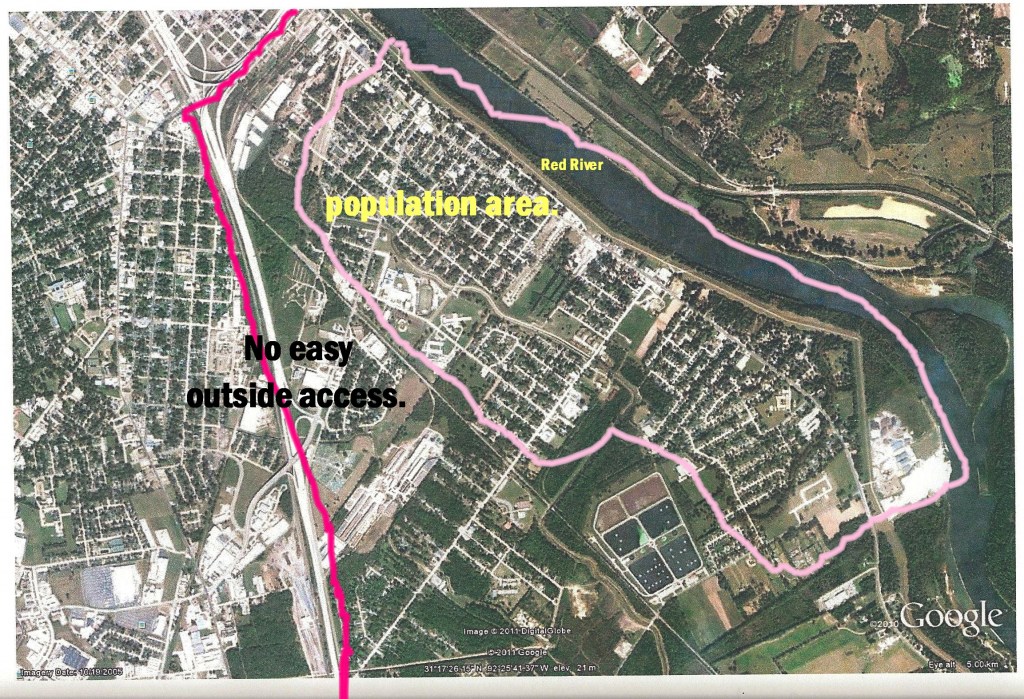
He asserts that the Great Wall of Alexandria, along with the Red River, chokes off the neighborhood, claiming that there is no easy access. Well, that is not entirely true. Actually, the neighborhood, arguably, has the best Interstate access in the City. Consider this instead:

The neighborhood is located on Louisiana Highway One. It is accessible from the Pineville Expressway, the Downtown Alexandria exit, the Broadway exit, and Sugarhouse Road (with plans for a future extension). AlexCenla writes:
Any corporation planner will see that traffic access to the area is minimal at best. Would you place a store in this area that even required a medium flow of traffic?
The river is a wall. The interstate is a wall. Access is severely limited.
Population is small.
Add it up and what do you get?
So, obviously, I disagree with AlexCenla that “traffic access to the area is minimal at best.” The neighborhood may have its own internal connectivity problems, but it’s easily accessible from multiple points. Also, the neighborhood’s population is not small; it’s actually one of the largest neighborhoods in the entire city. Importantly, during the last decade, it has grown in population, and developers have taken notice. Last year, a national retailer opened on Lower Third Street, and right now, there are construction crews on the ground, putting the finishing touches on a multi-million dollar, gated, moderate-income apartment community.
Its access to the Red River is not a liability; it’s an asset.
The issues confronting Lower Third have less to do with population or access; it’s about perception and capacity. It is a critically important and strategically located part of Alexandria, and there is ample reason to believe in believe in its potential and champion its redevelopment and renaissance.


 CenLamar
Leave a reply to Lamar White, Jr Cancel reply