In the immediate aftermath of the BP Deepwater Horizon disaster, Louisiana Governor Bobby Jindal aggressively pushed a controversial solution: the massive and rapid construction of a series of sand berms along the Louisiana coast. Governor Jindal’s proposal was swiftly criticized by a number of experts. They claimed the project was ill-conceived, that it could lead to additional environmental damages, and that it could potentially undermine the larger goal of coastal restoration.
Still, BP agreed to foot the bill, and the federal government provided the requisite permits.
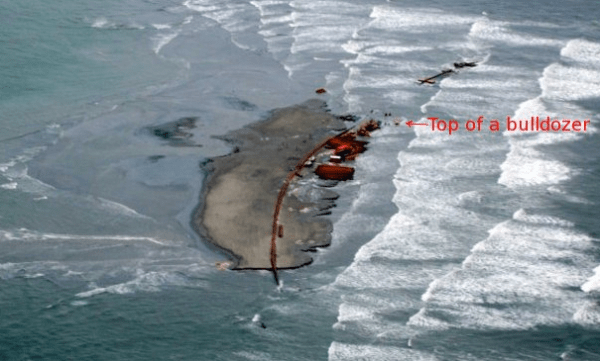
Today, more than a month after the well was declared officially “dead,” Louisiana is still constructing sand berms, ostensibly to help continue capturing oil (which is, without a doubt, still out in the gulf). But as reported recently in The New York Times, according to official estimates, the sand berms have, so far, captured only 1,000 of the 5,000,000 barrels of oil that leaked into the gulf. Quoting:
Gov. Bobby Jindal made the sand berms a signature element of his response to the oil spill last spring,exhorting federal officials to approve the project, and BP to foot the bill. So far the oil company has disbursed $240 million of a promised $360 million to the state.
Yet many scientists say the remaining oil from the spill, the largest in United States history, is far too dispersed to be blocked or captured by large sand structures.
“It certainly would have no impact on the diluted oil, which is what we’re talking about now,” said Larry McKinney, who heads the Gulf of Mexico research center at Texas A&M University in Corpus Christi. “The probability of their being effective right now is pretty low.”
So far, the berms have captured only 1,000 barrels of oil, according to official estimates, compared with the nearly five million barrels believed to have spewed from the BP well over all. By contrast, more than 800,000 barrels of oil were captured by BP at the wellhead, and roughly 270,000 barrels of oil were burned off by Coast Guard vessels offshore. Skimming operations, meanwhile, recovered at least 34 million gallons of oil-water mixture.
Ron Morris, a former Coast Guard captain and general manager of an oil spill response company on Alaska’s Prudhoe Bay, called the berms’ 1,000 barrels a paltry amount.
“That’s not an awful lot of oil in the grand scheme of things,” said Mr. Morris, whose company sent 44 workers to the gulf to assist in the response effort and cleanup. “It probably wasn’t worth the dollars that they put into it.”
Without a doubt, as the Times also points out, the project has been good for Louisiana industry. It’s a $360 million construction project.
But the question shouldn’t be about whether or not a $360 million construction project would be good for Louisiana industry; that should be self-evident. The question should be: Is this the best and most effective investment we can make?
Remember, the project has always been controversial. From the very beginning, scientists questioned the merits and the effectiveness of the project. In September, the Environmental Protection Agency issued a stern rebuke of Jindal’s intransigence on the sand berm project. From WWLTV:
Federal environmental regulators are blasting Gov. Bobby Jindal’s $360 million plan to block oil from the BP spill with sand berms, saying barriers built so far are ineffective and threaten wildlife.
In a Sept. 7 letter made public Thursday, the Environmental Protection Agency urged the Army Corps of Engineers to turn down the state’s recent request to build 101 miles of sand berms to stop oil from contaiminating shores and marshlands. The state needs permission from the Army Corps to complete the project.
The sand berms — paid for with $360 million from BP — have drawn criticism from coastal scientists and federal regulators. Critics say the work was ill-conceived and would damage the environment. Still, Jindal has made the sand berms a cornerstone to his strategy to fight the Gulf of Mexico oil spill.
Now, with the well dead, to many, the project seems “pointless,” a waste of time and precious money that could be used, instead, for more sustainable coastal restoration projects. Again, quoting from the Times:
Some scientists and federal officials suggest that the remaining money allocated for the berms might be better spent on other coastal restoration projects, a move that BP says it would support. The money could be spent, they say, on barrier island restoration, for example, in which dredged sand is used to bolster existing islands, mimicking natural processes.
In other words, BP would support spending the remaining $120 million it has pledged for sand berm construction on other projects, like barrier island restoration (which has the added benefit of better protecting Louisiana from hurricanes). Although Governor Jindal is technically directing “BP’s money,” not taxpayer money, we had and still have an opportunity to compel a foreign oil company whose negligence resulted in what could be the largest ecological and environmental disaster in American history to help rebuild our coast.
It seems like a no-brainer.
And the best thing is: People have been studying this for decades. Scores of scientists and engineers have built their careers around Louisiana coastal restoration. There are immediately implementable, shovel-ready projects that BP could and would be paying for otherwise. If we don’t pay for them with sand berm money from BP, then we’re going to have to pay for them with taxpayer money.
I don’t have any special insight about Mr. Jindal’s decision-making process on this issue. Some have accused him of listening to self-interested engineers instead of heeding the advice of coastal scientists, government agencies, and other professionals. The Shaw Group, a Fortune 500 engineering and construction firm headquartered in Baton Rouge, is the prime consultant on the project, and as reported by OpenSource, they’re also one of Governor Jindal’s top three campaign contributors.
It is worth noting, however, that Jim Bernhard, the founder and CEO of Shaw, is also the former Chairman of the Louisiana Democratic Party and a major donor to Democratic candidates and causes. To me, it’s not particularly surprising that Shaw, the only Fortune 500 headquartered in Louisiana, has donated a little less than $25,000 to Jindal, over the course of his entire political career. As critical as I have sometimes been about the Governor, I seriously doubt his decision to promote the sand berm project had much, if anything, to do with campaign contributions; Jindal believed in this project. He staked a lot of his own political capital on this project, and in the process, he made news– challenging the criticism from federal agencies and experts and asserting that he, the Governor of Louisiana, understood the solutions better than the President or anyone else in the Obama Administration. For the most part, it was a public relations victory for Jindal. At least in the immediate term.
But at some point, those of us in Louisiana need to assess whether this decision was wise at the time, and more importantly, whether or not it is necessary to continue a project that even the Governor’s Administration admits to be fraught with delays and hang-ups.
Interestingly, two days ago, Garrett Graves, Governor Jindal’s Director of Coastal Affairs, responded to a YahooNews report on the sand berms and Shaw’s donations to Mr. Jindal:
This was all about who could get it done quickly. The benefit of using Shaw is that they are a Louisiana-based company that cares about Louisiana’s coast. They are one of the few companies that were capable of managing something of this size and scope.
But only days before, Mr. Graves told The Wall Street Journal that Shaw had not “delivered what they promised,” suggesting that Shaw could have “picked up the pace” by hiring “foreign” dredgers to assist them. On one hand, the project has been great for Louisiana industry, but on the other, it’s been hindered by a reluctance to outsource more of the work.
To me, the Jindal administration seems to be towing an untenable line, all in an attempt to sell – what appears to be- a massive misallocation of resources, the definition of the word “boondoggle.”


 CenLamar
Leave a reply to E.J. Cancel reply