According to a recent report by Human Rights Watch, students with disabilities are much more likely to be spanked or subjected to corporal punishment than students without disabilities. Quoting from the press release:
In the 70-page report, “Impairing Education: Corporal Punishment of Students with Disabilities in US Public Schools,” the ACLU and Human Rights Watch found that students with disabilities made up 18.8 percent of students who suffered corporal punishment at school during the 2006-2007 school year, although they constituted just 13.7 percent of the total nationwide student population. At least 41,972 students with disabilities were subjected to corporal punishment in US schools during that year. These numbers probably undercount the actual rate of physical discipline, since not all instances are reported or recorded.
Corporal punishment, legal in 20 states, typically takes the form of “paddling,” during which an administrator or teacher hits a child repeatedly on the buttocks with a long wooden board. ACLU and Human Rights Watch interviews found that students with disabilities also suffered many other forms of corporal punishment, including beatings, spanking, slapping, pinching, being dragged across the room, and being thrown to the floor.
The report found that some students were physically abused for conduct related to their disabilities, including students with Tourette syndrome being punished for exhibiting involuntary tics and students with autism being punished for repetitive behaviors such as rocking. In some cases, corporal punishment against students with disabilities led to a worsening of their conditions. For instance, some parents reported that students with autism became violent toward themselves or others following corporal punishment.
The report is alarming, though not too surprising, and it underscores the need to ban corporal punishment in the twenty states where it is still legal, including the Great State of Louisiana. No doubt, there are many “advocates” of corporal punishment who believe such methods serve as a deterrent. And it may. But it doesn’t belong in the school, where educators and administrators are often uninformed about a child’s specific problems or disabilities. It should not be the prerogative or responsibility of the American public education system to inflict physical or bodily harm on school children, particularly when we know that disabled students are disproportionately targeted.
I am a disabled American, and I am also a product of the Louisiana public school system. I never had a teacher even threaten corporal punishment against me, except for once, in sixth grade, when a teacher terrified me by saying she wanted to rip my fingers off (I had been accused of flipping off a fellow student, not one of my best moments). But I can recall, very vividly, thinking how ridiculous and cruel it was for a teacher- an adult- to physically threaten a kid who, at the time, got around with a walker.
The New York Times picked up on the study and recently published a story about it, which included this revealing graphic:
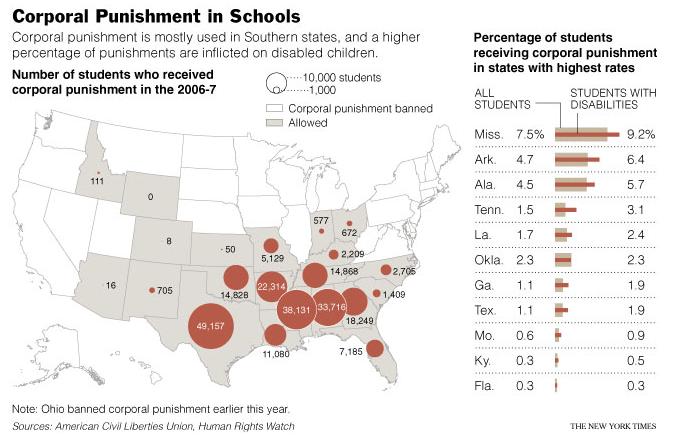
In Louisiana, 1.7% of all students received corporal punishment, compared with 2.4% of disabled students. This is simply unacceptable.
I know we’re rolling back our educational standards here in Louisiana, championing a new high school diploma without all of those pesky “academic” requirements as if we’re on the cutting edge of education. But to me, this is a terrible problem with an easy fix: Ban corporal punishment. Thirty other states in the union have already done so, and if you study this map carefully, you’ll notice those states tend to rank way higher in education than those that allow corporal punishment.
In other words, there doesn’t seem to be a causal relationship between corporal punishment and academic excellence.


 CenLamar
Leave a reply to Lamar White, Jr Cancel reply