Only a few months after our Governor publicly opposed the federal stimulus, even going so far as to say he would reject some of the stimulus money for Louisiana, he’s now appearing throughout the State, distributing jumbo-sized checks and channeling the spirit of the late Ed McMahon, which definitely makes for some great photo opportunities.
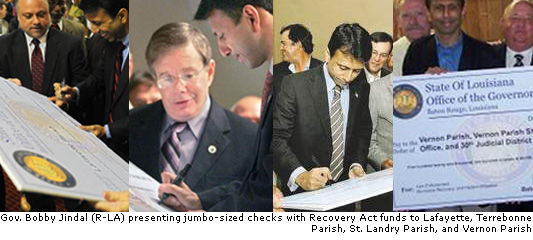 (Photo credit: Think Progress)
However, it’s hard not to appreciate the irony: Much of the money Jindal has been doling out is, in fact, stimulus money, a fact that, to his credit, Jindal acknowledges. Just last week in Politico, Jindal criticized the stimulus as “a stimulus that has not stimulated.” Prior to that, as you may recall, Jindal appeared on national television to deliver the Republican response to President Obama’s first address to a joint session of Congress, during which Jindal lambasted monies set aside for high-speed rail infrastructure and, most notably, “volcano monitoring,” a curious criticism from a Governor who leads a State that should be well-aware of the value of preventative planning and research for natural disasters and a claim that infuriated many in the scientific community and in the State of Alaska. From CNN (bold mine):
Jindal has been a vocal critic of the stimulus package, highlighting what he considers waste at a White House meeting with governors on Monday and in his speech Tuesday. He noted $300 million to buy new government cars, $8 billion for high-speed rail projects and $140 million “for something called ‘volcano monitoring.’ ”
“Instead of monitoring volcanoes, what Congress should be monitoring is the eruption of spending in Washington,” Jindal said.
Jindal, seen as a possible contender for the 2012 GOP presidential nomination, has announced plans to reject $100 million of stimulus funding for his state, saying it would require Louisiana to change its unemployment laws. Several other governors have expressed similar concerns.
To be fair, Jindal was not the most extreme in his stance against the stimulus. Unlike Governor Sanford, who flirted with rejecting the entire stimulus outright, Jindal likely saw the writing on the wall and realized that, despite his best efforts, the stimulus would pass, providing the State of Louisiana with billions in additional federal dollars that he couldn’t afford to reject.
Supporters of Jindal may claim that his opposition to the stimulus had less to do with its overall need and more to do with opposition to individual programs funded by the stimulus and the lack of a true bipartisan consensus, a compelling argument to be sure. The problem with this argument, however, is that throughout the month of February, Governor Jindal made it abundantly clear that he was “fundamentally opposed” to the entire package. This is what Jindal told David Gregory on Meet the Press on February 22, 2009 (bold mine):
I think we just have a fundamental disagreement here. I don’t think the best way to do that is for the government to tax and borrow more money. I think the best thing they could’ve done, for example, was to cut taxes on things like capital gains, the lower tax brackets, to get the private sector spending again. I think they had a provision the net operating losses to help small businesses. Unfortunately, they slimmed that down. They could’ve done some things on a real energy policy. If all they do is borrow federal money and give it to the states, all we’re really doing is delaying the inevitable. We’re eventually going to have to make these hard choices anyway.
Fair enough. Jindal believes tax cuts would be more effective at stimulating than targeted, large-scale spending. But it is important to remember that included in the $787 billion stimulus package was $287 billion (36%) in tax cuts. Jindal may believe the “stimulus has not stimulated,” but he has to concede that this stimulus included one of the largest tax cuts in American history. Incidentally, some Democrats are now blaming these tax cuts for derailing much-needed transportation infrastructure funding. From The Hill:
Congress cut taxes by too much and did not include enough money for transportation projects when it passed a $787 billion stimulus bill this year, the Democratic chairman of the House Transportation and Infrastructure Committee said Monday.
Rep. Jim Oberstar (Minn.) stopped short of saying Congress should move a second stimulus, as some Democrats have recently suggested. But he told The Hill on Monday that lawmakers could create jobs by passing his own big-ticket public-works legislation: a $500 billion surface transportation reauthorization bill.
…
Oberstar said a better option than a second stimulus would be to pass his bill authorizing highway, rail and mass transit projects over the next six years. He also said Democrats need to be more patient with the first stimulus.
“Let’s make sure this portion is working well before you talk about the next one,” Oberstar said of the first stimulus. He expects by Labor Day to see 250,000 new construction jobs, another 30,000 jobs in bus and train manufacturing and 25,000 new jobs for work on water projects.
“All of that is moving and the pipeline is in full swing. Then, I think by March of next year, you could reassess and move ahead with a second injection,” he said.
One thing he’s sure of is that Democrats focused too much on tax cuts in the stimulus bill.
Although it may be politically convenient to blame the (predominately middle class) tax cuts included in the stimulus for preventing the type of large-scale infrastructure work needed in this country, there is no doubt, despite what Michael Steele may have us believe, that investing in infrastructure directly creates jobs, stimulates the private sector, and improves our overall quality of life. Republicans may blame Democrats for not focusing on shovel-ready infrastructure, and Democrats may blame Republicans for failing to contribute anything of value. Despite the the inclusion of many Republican-endorsed amendments, the bill failed to get a single Republican vote in the House and only three in the Senate. Regardless, after nearly three decades of deregulation and tax cuts for the wealthiest Americans, it is difficult to understand how the formula that spurred a great recession could be the same formula that solves this recession.
Which brings me back to our good Governor:
Despite his performance during the Republican response to President Obama, Bobby Jindal is still a rising star in the Republican Party, and as a potential Presidential candidate, it’s probably important for him to continually oppose President Obama’s big ticket agenda items. As a politician, that is his prerogative, but as Governor of the Great State of Louisiana, he should be the first to recognize the ways in which a large-scale infusion of federal dollars, particularly in economically depressed areas, can help stabilize and stimulate. The New York Times picked up on this back in April, observing that Louisiana may serve as a model for the federal stimulus:
Years before Washington spent $787 billion on a national stimulus bill, it staged an unintended trial run in Louisiana, a huge injection of some $51 billion for which historians find few, if any, precedents in a single state.
….
State economists specifically mention what one called “the ongoing building boom” from federal dollars as a main reason for the numbers. Largely a result of the damage caused by Hurricane Katrina, construction projects have not dried up as they have elsewhere, and a few can even be seen in downtown New Orleans.
Construction has “really hung in there and done very well,” said Loren Scott, an emeritus professor of economics at Louisiana State University. “In most states construction is way down, but in ours it has been up.” The relatively low unemployment rate in Louisiana “tells you that the stimulus can have an effect,” Mr. Scott said.
….
But even as Mr. Jindal has criticized the stimulus bill, his own subordinates have continued to request money from Washington, notably in replacing Charity Hospital, which for generations served the poor in downtown New Orleans.
….
In Louisiana, however, the consequences have hardly been dire — just the opposite, in fact. One of the governor’s leading aides, the state’s recovery director, Paul Rainwater, praised the federal relief effort in Louisiana in recent remarks to Congress, the day after his boss scorned federal help on national television in the Republican Party’s response to President Obama’s first address to Congress.
“No other state in the nation has been blessed with such generosity from Congress and the American people,” Mr. Rainwater said.
The Times makes an interesting point and one worthy of further thought and consideration. When our elected officials speak about the strength and (relative) health of the Louisiana economy despite the national economic recession, it is important to acknowledge two things: Our baselines in Louisiana were already abysmally low, and our economy has definitely been bolstered by billions in federal recovery dollars.
Jindal, it seems, would like to have it both ways: He appears on national television and writes opinion pieces in national publications decrying and blasting the effectiveness of the stimulus while touring around the State distributing stimulus money for worthy projects. He speaks about the health and resilience of the Louisiana economy without also acknowledging the ways in which the expenditure of billions of federal recovery dollars have directly contributed to the State’s economy.
Governor Jindal is not the only Republican official in Louisiana who seems to be having a difficult time balancing his beliefs on the stimulus. Today, the Louisiana Democratic Party blasted Senator David Vitter for essentially flip-flopping on the stimulus. Quoting:
Months after railing against the economic stimulus plan that became law earlier this year as wasteful and ineffective, U.S. Senator David Vitter yesterday proposed the allocation of $7 billion in stimulus funds for infrastructure projects he claims will boost the economy.
In February, Vitter said the economic stimulus plan before Congress amounted to “little more than a laundry list of government spending projects.” Vitter referred to the stimulus bill as “more pork-barrel spending” which would not “promote real economic growth and help create jobs.” [Release 2/10/09]
Yesterday, however, Vitter made a full about-face, asking the Senate for unanimous consent to spend $7 billion of the stimulus funds on what he called “shovel-ready’ infrastructure projects… that are vital to our economy and communities.” [Release 7/29/09]
“Once again, David Vitter has proven himself to be among Washington DC’s leading advocates of hypocrisy and empty political rhetoric,” said Louisiana Democratic Spokesman Kevin Franck. “David Vitter can preach conservative values and fiscal discipline all he wants, but in practice he’s a philanderer who always seems to bring home his share of pork.”
Franck said the Louisiana Democratic Party does not oppose fully funding the National Highway Trust Fund or the use of stimulus funds to create jobs in the state.
“Funding infrastructure projects like I-49 North, LA 1 or I-10 is absolutely vital for Louisiana’s economy and we’re glad David Vitter thinks so today, even though he said the exact opposite a few months ago and no one knows for sure what he’ll say tomorrow,” Franck added.
A quick digression: Vitter also made news two days ago. In an article reported in The Washington Times, Vitter attempts to defend Republicans from the South against statements made by Ohio Republican Senator George Voinovich, bemoaning the alleged takeover of the Republican Party by inarticulate Southerners and singling out Senators Jim DeMint and Tom “Dr. No” Coburn. In all fairness, I also can’t stand DeMint and Coburn, but either way, Voinovich’s comment was stupid. Maybe it’s true that Southern Republicans are ruining the party, but if you’re only going to drop two examples, try to make sure that both of them are actually Southerners. Senator Tom Coburn is from Oklahoma, and Oklahoma may have a lot of wide open spaces and country farms. But it’s not the South.
In defending his fellow Southern Republican Senators, Vitter reintroduced a phrase that formed the basis of his first Senatorial campaign: “conservative values.” Quoting:
Sen. David Vitter disagreed Wednesday with criticism that Southern Republicans are ruining the party and said a return to conservative values is the best way to restore political power.
“I’m on the side of conservatives getting back to core conservative values,” said Mr. Vitter, Louisiana Republican and member of the Senate Armed Services Committee. “There are a lot of us from the South who hold those value, which I think the party is supposed to be about. We strayed from them in the past few years, and that’s why we performed so badly in the national elections.”
I won’t go after the low-hanging fruit here, but suffice it to say, given his track record, David Vitter would be well-advised to avoid speaking about using so-called “conservative values” as a means to “political power.” Free advice: Instead of using the word “values,” use the word “principles.”
Anyway, back to the story at hand:
I doubt anyone has a problem with a Senator’s ability to bring home the bacon. But it certainly seems as if both Jindal and Vitter split against the President’s stimulus bill for ideological reasons. And now that checks are being written and funds are being dispersed, both of these men, ironically, are using stimulus funds to their own political advantage, which could pose two problems:
1. Accepting billions of dollars in stimulus funding they both believe to be unable to stimulate should create the very type of (hypothetical) economic environment both Vitter and Jindal ostensibly fear will destroy America. Put more simply, by accepting this funding, they are contributing to and enabling an economy they claim is doomed to failure. If the stimulus turns out to a complete failure (which does not seem likely), they may be able to say, “I told you so.” But they won’t be able to deny their own active complicity.
2. If the stimulus proves to be successful (something, I believe, we won’t be able to measure for at least six to eight more months), then, no matter how much they may share in that success as elected officials, any worthwhile opposition will remind the public that, if Vitter or Jindal had it their way, Louisiana would be at the very least $7.6 billion poorer. And it wouldn’t be too difficult to tie in a laundry list of projects in all corners of Louisiana that benefited because of stimulus money.
So, in the meantime, Vitter quietly attempts to ask for $7 billion (nationally) in stimulus funds, and the Governor delivers over-sized vanity checks.
It may be more difficult for Vitter to cover his tracks, but Jindal, at least, understands that it is probably not in his political best interest to show how the stimulus is actually working in Louisiana. Already, his administration has refused to place signs that identify stimulus projects; after all, despite the funding source, Bobby Jindal is the name on the dotted line.


 CenLamar
Leave a reply to Drew Ward Cancel reply