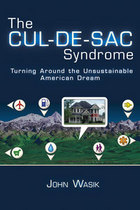
 This afternoon, I read the recently published book, The Cul-De-Sac Syndrome: Turning Around the Unsustainable American Dream by John K. Wasik. Throughout the past few months, I have been contemplating a post on how the current economic recession was fueled, in part, by the machinery of sprawl development and the unsustainability of what former President George W. Bush referred to as “the ownership society.” For decades, America has subsidized expansion and sprawl, neglecting and disinvesting in our urban areas and inner-cities and, instead, investing billions and billions of dollars in order to expand road, drainage, sewage, and utility infrastructure to encourage and complement the development of vast, never-ending swaths of suburbia.
Mr. Wasik’s book reveals, in no uncertain terms, how the economics and the subsidization of sprawl, along with an overbearing emphasis on home ownership (at any cost), have contributed to the blight and decay of inner-cities across the nation. The problem was, of course, amplified and underlined by the collapse of subprime mortgages and the proliferation of home foreclosures, but for many people, it should come as no surprise that we were doomed to failure. Not only were millions of people buying houses they could not afford, the government, on all levels, helped to create those conditions by rubberstamping and subsidizing this expansion, with little to no regard of the opportunity costs or of the negative effects– increased energy consumption, an over-reliance on the automobile, plummeting property values in formerly vibrant neighborhoods and downtowns, and, ironically, increased exposure to health risks.
When I hear people dismiss smart growth as some type of socialistic experiment, I can’t help but laugh. Without a doubt, many of the same folks who reject an intuitive reinvestment in inner-city neighborhoods have no appreciation of the massive government subsidization in the suburban sprawl they hold up as “the free market.” Nor do they really care. For critics, it’s mainly about lifestyle, not about economics.
And when I hear people argue that the public should not spend a penny in areas plagued by blight and crime, I usually cringe, particularly considering that, in my own experience, most of the people making such an argument are the beneficiaries of millions of dollars in public infrastructure and public services, augmenting the values of their large-lot single-family homes, their schools, and their parks and recreation facilities. (By the way, I am not, in any way, suggesting that people, like me, who live in large-lot single-family homes are somehow universally opposed to inner-city reinvestment– just that the vast majority of the small minority of critics are attempting to argue bad economics to justify a lifestyle decision, a decision, by the way, that is in no way being threatened by a focused effort in the inner-city).
Oh, and there is one more thing: Studies prove that reinvesting in existing infrastructure and encouraging in-fill, densified development can create substantial opportunities in the private-sector and, on the whole, best ensures the public’s return on investment. (I will expand on this in a subsequent post).
I don’t wear rose-colored glasses, and I don’t believe it’s honest or appropriate to gloss over the significant challenges that we face, as a community, a State, and a nation. If we could snap our fingers and immediately redevelop our inner-cities, we would have snapped our fingers years ago. It’s just not that easy.
We are all ill-served when we refuse to base our decisions on reality-based assumptions and instead prefer abstract hypotheticals. There are a couple of reasons that some areas of Alexandria have been able to attract retail and commercial opportunities and some haven’t, and we should all be honest:
1. Although traffic count is important, retailers care much more about population density and median household incomes. There must be a critical mass of residents within a certain pre-defined service area, and the median household income of the area should indicate that residents have the buying power to purchase products at the retailer’s price points. National retailers do not base their decisions on emotions; they look at the numbers. The higher the population density and the greater the median household income, the more attractive an area is to a developer. Incentives and infrastructure matter, of course, but in today’s recessionary economy, retail and commercial developers (at least those whose projects actually ADD value to an area) aren’t going to take on feel-good projects unless their business model is sustainable.
2. Again, incentives and infrastructure matter. Before our inner-city can truly avail itself to value-adding and job-creating private sector developments, we must improve existing infrastructure. No one personally courted Wal-Mart to develop a new super store on Highway 28, for example, and Wal-Mart’s decision had nothing to do with the desires of a neighborhood organization. (Incidentally, in an underdeveloped area, neighborhood groups are much more effective when they focus on the master planning and macro-economic issues of their neighborhood, instead of being preoccupied by political issues and the promise of micromanagerial control– which, to an outside developer, makes a neighborhood group appear more like a special interest and less like an authentic champion). For better or worse, Wal-Mart came because they knew rooftops were popping up all around the corridor, moderate and high-income residents, and all of the surrounding infrastructure was new and well-built. Moreover (and somewhat bizarrely), Wal-Mart actually received incentives to build on the edge of town.
As they say, patience is a virtue, and throughout the country, leaders are recognizing that improving and increasing access to affordable housing in the inner-city is the most critical first step in revitalization. Of course, in the inner-city, there is not nearly as much land for a massive development of large-lot single-family homes as there is in the suburbs; however, there are ample opportunities for densified developments (which can more efficiently increase population, raise household income, respond to a documented need, create a desirable environment for retail and commercial developers, and better maximize publicly-funded services).
We would all be mistaken if we believed the best way to redevelop our inner-city is by attempting to replicate sprawl models. The very first objective of reinvesting in an inner-city, not just in Alexandria but in communities all across the nation, should be increasing the standard and quality of life for existing residents, which means improving existing infrastructure and encouraging the development of quality, affordable housing. Until then, we won’t be able to attract quality retail and commercial developments.
It is a simple formula:
A = Median Household Income/ Population Density
B = Quality Infrastructure
C = Opportunities for Retail and Commercial Development
A + B = C
Certainly, home ownership is important, but if we have learned anything about this issue during the past three years, it is that home ownership is not a panacea and that (perhaps somewhat counter-intuitively) over-emphasizing ownership can cause people to live way beyond their means, inadvertently decreasing discretionary spending (spending that is often bankrolled by home mortgages) and thereby also decreasing buying power.
Even more importantly, private-sector development decisions are reality-based and evidenced-based; there is little room for “emotional appeal.” Your house may be worth $1 million to you, even though it’s only worth $150,000 to everyone else, but if you need the money and you want to sell, you should probably recognize that no one is going to pay a premium for your emotional attachment. Sorry.
And the same thing applies to commercial development: Despite America’s renewed interest in redeveloping inner-city and inner-core neighborhoods, development is still contingent on raw, objective, unemotional facts and numbers. If anyone claims otherwise, then you should ask them if they are willing to put their money where their mouth is; if not, well, they simply do not know what they are talking about.
Although this post is, in no way, a book review, I highly recommend The Cul-De-Sac Syndrome to anyone who is truly interested in learning about the history and the causes of the American housing collapse.


 CenLamar
Leave a reply to perpetualrenovator Cancel reply