Last week, Lamar and I headed down to Marksville for this year’s annual meeting of the Louisiana Council of Farmers’ Cooperatives. The early weather was crisp as we watched the scenic transition from the charming old low-density urban core of Alexandria’s Lower 3rd Street to the gentle rural parkway that is Louisiana Highway 1 in Rapides and Avoyelles Parishes. Historic Downtown Marksville also offers a handful of classic community amenities, so before leaving town we ate at a local lunchroom bar, Rudy’s.
The meeting’s agenda was what really drew us down to the agricultural seminar: a group of five local experts were speaking on topics ranging from energy crops to carbon credits. Many young Americans have an especially strong and long-term interest in the future of this issue, and we have previously discussed the possibilities for Louisiana rural development presented by alternative energy and the new biofuels industry. We arrived to find a group of about thirty serious and attentive agricultural entrepeneurs (my fancy word for these forward-looking farmers).
Mark Zappi of the University of Louisiana at Lafayette opened with a general discussion of the future of biomass utilization. His argument, echoed throughout the day, was that the emerging bio-industry is not unlike that of petroleum: current oil refining focuses on making products like asphalt, plastics, and chemicals in addition to gasoline, so the viability of bio-industry depends upon developing ways to maximize the efficiency of not only making alternative fuels, but biotechnical products as well.
And then there are lignocellulosic bioproducts, which some researchers believe to be the future of the bio-industry. This could allow for the glue (lignin) and building blocks (cellulose) of stalks or woody biomass to be used as feedstocks, which would move the industry away from using foodstocks as energy feedstocks and limit regional food shortages (which resulted in last year’s Mexican tortilla price spike). Many experts believe we are one major or a few minor technological breakthroughs away from making the process economically viable. Others, though, such as Dr. Ed Richard below, are still convinced that biotechnology, and not cellulosic biofuels, could be key to the sustainability of bioenergy production.
Another concern for biofuel producers should be the emergence of biocrude, which can be processed in existing petroleum refineries and would enable Big Oil companies to aggressively enter the alternative fuel market.
Kelsey Short of the Louisiana Department of Economic Development next discussed a number of emerging projects in the State of Louisiana, including the location of a chicken fat biofuel plant in Geismar.
Following him was Dr. Theodore Kozman, also of ULL, who briefly introduced the group to the important energy efficiency work being done at the Louisiana Industrial Assessment Center, which offers industrial plants a free efficiency audit. Because energy prices are unlikely to go down much or at all, energy efficiency is one of the best ways a company can keep their energy costs similar to recent years.
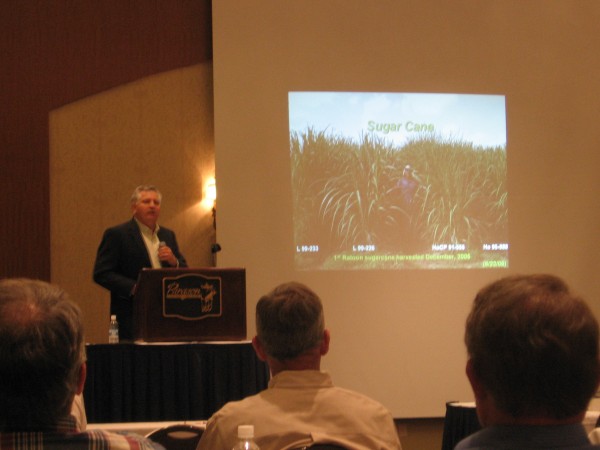
Dr. Ed Richard (shown below) of the USDA Sugarcane Research Unit in Houma came on to describe his research in sugar cane, energy cane, sweet sorghum and others to maximize their potentials as feedstocks for biofuel production. One crop does not fit all, and it’s important to consider conversion processes and efficiency in this emerging industry.
Lastly, Dr. Charles C. Reith of PACE Global (who formerly taught sustainable development at Tulane) came on with a fascinating talk on the future of Renewable Energy Certificates and Carbon Credits. The use of Renewable Energy Certificates is currently voluntary but vigorous in the United States. Dr. Reith pointed out that all three major Presidential candidates have said they would sign a law to initiate a national market for carbon trading, in which polluters would be required offset their emissions by purchasing credits from organizations whose activities reduce greenhouse gases. This model has been shown to work in American air quality markets, which reward innovation, competition, diversity, and dynamicism.
Savvy companies and organizations are already determining if their “carbon porfolio” is an asset or a liability, and what things they can do to reduce their carbon footprint, though Louisiana still lacks an infrastructure for carbon trading. There is still a great deal of uncertainty with respect to alternative energy solutions and biofuels, but as in any emerging industry (think Silicone Valley twenty years ago), intelligent risk-takers and early actors stand to gain a great deal.
It is important to remember that almost every place is predisposed to certain opportunities when it comes to renewable energy, and even though corn-based ethanol or soybean oil biodiesel will likely not save the world, local and rural economies can take advantage of the short- and medium-term economic benefits of these technologies, provided our State does not put all of its eggs, so to speak, in one basket.


 CenLamar
Leave a reply to Anonymous Cancel reply