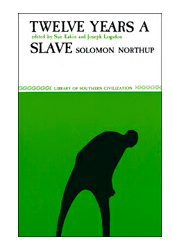
Only a few months before she passed away, I passed along a “top secret” message to my Great Aunt Sue Eakin. Aunt Sue was, arguably, Central Louisiana’s most accomplished historian. She and her sister Manie wrote the textbook that, for decades, was used in seventh and eighth grade Louisiana history classes, so chances are, if you attended junior high in Louisiana, you’ve read her work. But without question, her greatest professional accomplishment was editing Solomon Northup’s Twelve Years a Slave, reintroducing the seminal slave narrative to the American public, 115 years after it was originally published. Northup’s story, in many ways, was personal to Aunt Sue.
She, my grandmother Joanne, and their family were all born and raised in a small plantation on the banks of Bayou Boeuf, the setting for much of Northup’s book. As a professor at Louisiana State University at Alexandria (LSUA), Sue worked, as an academic, on the very same land that Northup had once lived as a slave. And as a lifelong resident of this small pocket of Louisiana and a dedicated historian, Aunt Sue embraced her role as its curator.
Three years ago, while working in the Mayor’s office in Alexandria, I learned that at least a couple of Hollywood producers were seriously considering adapting Twelve Years a Slave into a big budget motion picture. I even exchanged a few e-mails with one group. I didn’t want to get my hopes up; during the last few years, due, largely, to Louisiana’s aggressive incentives for movie productions, I’d heard all sorts of rumors about the Next Big Movie, most of which haven’t yet materialized. But this was different. The people who were expressing interest in Twelve Years a Slave weren’t scouting for locations or incentives; they were researching the source material. They wanted to speak with my Aunt Sue and her family. I called my grandmother. “This may not be for real,” I said, “but you should call your sister Sue and tell her that these Hollywood people want to talk to her about turning Twelve Years a Slave into a movie.” I knew that Sue, then ninety years old, was in poor health, that she wouldn’t be able to sit down for an interview. But I also knew how important it would be for her to know, in the twilight of her life, the story that had defined her professional career endured; that forty years after her edited version of Northup’s story was published, the story was still captivating people and that, maybe, just maybe, it was about to be told on the silver screen– to an audience not just of academics and historians but to the entire world. My grandmother called up her sister and told her the promising news. “She’s thrilled,” my grandmother reported back.
Aunt Sue passed away a few months later. Until a month ago, I hadn’t heard any news on the film’s development for over two years. And I suppose, cynically, I thought it had been shelved.
Boy was I wrong. I don’t know if the same folks with whom I had spoken are still involved in the project, but the news about this film is even bigger and grander than I had ever imagined.
Twelve Years a Slave is set to begin production this month. Directed by Steve McQueen and produced and starring Brad Pitt, the film already promises to be a blockbuster. Only three weeks ago, actors Paul Giamatti and Sarah Paulson joined the ensemble cast:
Helmer Steve McQueen continues to fill out the ensemble of his drama “Twelve Years a Slave,” as Paul Giamatti and Sarah Paulson have joined the cast of the New Regency pic based on Solomon Northrup’s 1853 nonfiction tome.
Duo joins Chiwetel Ejiofor, Michael Fassbender, Brad Pitt, Benedict Cumberbatch, Scoot McNairy, Ruth Negga and Garret Dillahunt.
Ejiofor stars as the book’s author, a free man kidnapped and sold into slavery. Paulson will play Fassbender’s jealous wife, while Giamatti will play Freeman, who takes possession of the slaves upon their arrival in New Orleans.
I don’t know if this film will be shot in Central Louisiana, but regardless, it tells one of the most significant stories in Central Louisiana history. This is big news for our region.
Kudos to the Eakin and the Lyles families, and three cheers for Aunt Sue, who spent her life telling and retelling a story she fiercely believed needed to be told.


 CenLamar
Leave a comment