
This is crazy:
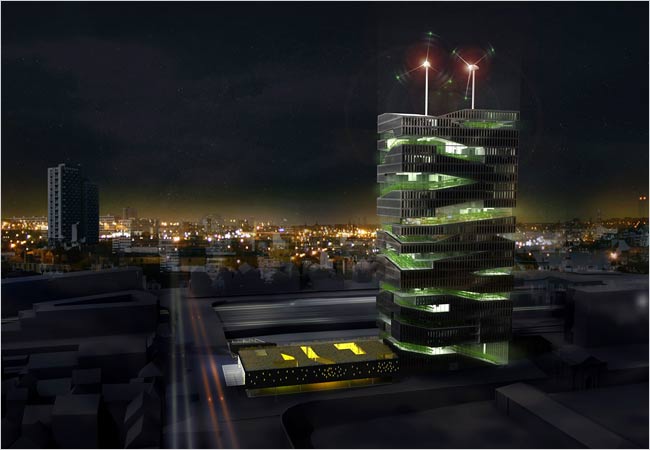
The New York Times is featuring an article about the “new interest in vertical farms.” Quoting:
The idea, which has captured the imagination of several architects in the United States and Europe in the past several years, just caught the eye of another big city dreamer: Scott M. Stringer, the Manhattan borough president.
When Mr. Stringer heard about the concept in June, he said he immediately pictured a “food farm” addition to the New York City skyline. “Obviously we don’t have vast amounts of vacant land,” he said in a phone interview. “But the sky is the limit in Manhattan.” Mr. Stringer’s office is “sketching out what it would take to pilot a vertical farm,” and plans to pitch a feasibility study to the mayor’s office within the next couple of months, he said.
“I think we can really do this,” he added. “We could get the funding.”
Dr. Despommier estimates that it would cost $20 million to $30 million to make a prototype of a vertical farm, but hundreds of millions to build one of the 30-story towers that he suggests could feed 50,000 people. “I’m viewed as kind of an outlier because it’s kind of a crazy idea,” Dr. Despommier, 68, said with a chuckle. “You’d think these are mythological creatures.”

 CenLamar
Crazy good or crazy bad?
Also, want to gloat that my little cousin wrote that NYTimes article.
Not such a crazy idea, its been around for a long time in different sicence fiction
layouts going as far back as the 1930’s with Flash Gordon. One way or another different writers hinted at this with the onset of world overpopulation… It could be done.
Maitri, that is so cool.
I think her article was crazy good, by the way.
I can envision how this concept could be feasible in the distant future, given the nature of land use and the desire for most people to live in dense, urban areas. Four out of five people live in metropolitan areas in this country.
I can easily see the application of this concept in a place like Tokyo or Singapore, where people are more densely packed and there isn’t a heck of a lot of agricultural land.
Also, think about places like Dubai and the UAE, where the climate prevents people from growing a variety of produce.
I think this would be a great use for the old LNB glass tower on 5th and Murray. Cover that ugly 1970’s monstrosity with tomato plants.
With India’s increasing agricultural and water woes, big cities like Mumbai and New Delhi ought to start looking at this as a viable and geographically proximal alternative.
How can this concept be scaled up for large quantities of wheat and corn?
Oh, I almost forgot: This is possible in urban desert cities like Dubai, etc. I lived in Kuwait during the late 70s and all of the 80s. In those 15 years, my father raised three different hydroponic gardens on our balconies, galleries, rooftop terrace, etc. We had lush tomatoes, swiss lettuce, peppers, different varieties of gourds as well as flowering plants,which attracted every pollinating insect in Kuwait. This can be done!
I really want to see this project succeed because I think this is could be a solution to are rising food shortage…I am trying to get the first working tower built: http://www.thepoint.com/campaigns/vertical-farm-in-new-york-city
Although i am a big supporter of upcoming new alternatives to our current system of reliance on oil and fertilizer, i think that we may be missing a much easier step.
Having huge food farms of this size, which would be very costly (in terms of R&D and materials) is only going to be ever viable in places of intense urban density, like NYC or Tokyo. It will not a viable option for most of places, due to capital and operating costs. We should be thinking of ways to reduce consumption of energy through this whole process, and we need to have options that are available to the poor.
I have a friend in New Orleans who is renting an empty space in the Marigny, about a half mile from the French Quarter. He has started a business as an ‘urban farmer.’ He is growing organic vegetables within the city limits, and local people can walk or bike to his urban farm (not a community garden – this is a small business independently operated to make a profit) to buy produce. He also is planning to begin supplying local food stores (like the nearby upcoming New Orleans Food Coop, http://www.nolafoodcoop.org) with a big wagon on his bicycle. These are true ‘carbon footprint free vegetables.’
His farm has taken very little capital and time to start up. What it takes is a change of lifestyle and culture that although may be uncomfortable at first, it is necessary. We can’t wait 30 years for these mega farm buildings to become economically viable to large corporations to start addressing real issues with water and food scarcity. Imagine if there was millions of dollars of investment in developing smalls scale urban farms in empty spaces in cities in towns all over the country? We would solve our problem, and never have to depend on such wasteful schemes.
But, best of luck to those involved!